
On this page
What is swing trading? Holding positions for days to weeks to capture one larger move. How it works in crypto, what it costs, and what it takes to do it well.
Swing trading is a trading style where you hold a position for several days to a few weeks, aiming to capture a single larger price move rather than a series of small intraday ones. A swing trader buys a breakout or a bounce off support, sets a stop loss, and waits for the move to play out. The chart timeframes are the 4-hour, the daily, and the weekly.
That patience is the entire strategy. Instead of fighting for ten small wins a day, you position for one 8% move a week and let the market do the work while you do something else.
In crypto, swing trading has some specific mechanics worth understanding before you place the first trade. This guide covers how it works, what a swing trade looks like with real numbers, what it costs to hold positions, and the one constraint that matters more than any indicator: the size of the account behind the trade.
What Swing Trading Is Built On
Every swing trade has the same four parts.
An entry based on structure. Swing traders enter where the higher-timeframe chart gives them a reason: a bounce off a support level that has held for weeks, a breakout from a range, a trend continuation after a pullback. The setup comes from the 4-hour chart or above. Anything on a 5-minute chart is noise at this holding period.
A stop loss below the invalidation point. The stop goes where the trade idea is wrong, usually below the swing low or the support level that justified the entry. Because swing setups are built on larger structures, stops sit further from entry than a day trader’s would: 3%, 5%, sometimes more.
A target based on the size of the expected move. Swing trades aim for the 5% to 20% moves that play out over days. The wider stop only makes sense because the target is proportionally larger. Most swing traders want at least twice as much upside as downside before they enter.
Time. This is the part that separates swing trading from everything else. After entry, the job is to leave the position alone. Check it once or twice a day, move the stop up if the trade develops, and otherwise stay out of its way.
A Swing Trade With Real Numbers
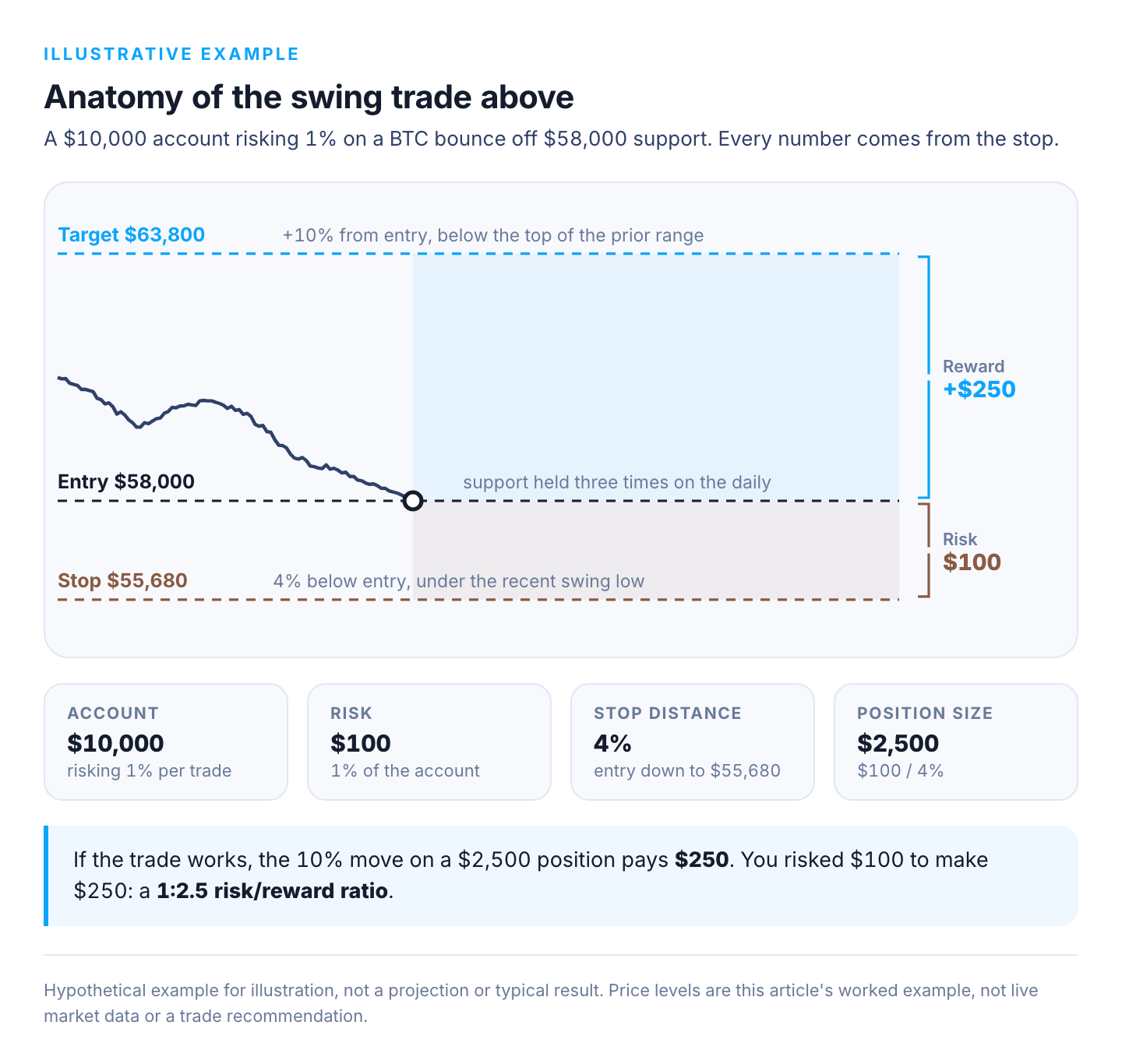
Say BTC has pulled back to $58,000, a level that has held as support three times on the daily chart. You decide the setup is invalid if price breaks below the recent swing low at $55,680, which is 4% under your entry.
You are trading a $10,000 account and risking 1% per trade, which is $100. Position size is your risk amount divided by the stop distance: $100 / 4% = $2,500 of BTC.
Your target is $63,800, a 10% move up from entry, just below the top of the prior range. If the trade works, a 10% move on a $2,500 position pays $250. You risked $100 to make $250, a 1:2.5 risk/reward ratio.
Now the costs. Trading fees at typical rates run around 0.04% to 0.05% per side, so roughly $1 to $1.25 to open and the same to close. If you hold the position for six days with leverage, funding costs at a typical baseline of 0.01% per 8 hours add up to about 0.18% of the position, or roughly $4.50, and the cost runs against your side more often than not. Call it $7 in total costs on a $250 winner. About 3% of the profit.
That cost profile is the quiet advantage of swing trading. A day trader capturing small moves gives up a much larger share of each win to fees, because the per-trade profit is smaller while the fee rate is the same. Swing trading earns bigger chunks per trade, so the costs shrink in proportion.
Why Crypto Suits Swing Trading
Crypto’s structure works in a swing trader’s favor in three ways.
The market never closes. There are no weekend gaps, no overnight sessions you are locked out of. Your stop loss is live at 3am on a Sunday. In equities, a stock can gap through your stop overnight and fill you far below it; in crypto, the market trades continuously through the level.
The moves are large. Crypto regularly produces the 10% to 20% weekly swings that this style is built to capture. A stock swing trader might wait a month for the kind of move BTC can print in a week.
The volatility cuts both ways, though. The same market that delivers a 10% move in your favor can deliver it against you while you sleep. Swing trading crypto means accepting overnight risk as a standing condition. Your defense is the stop loss and position sizing, never hope.
There is one recurring cost to respect: holding a leveraged position across days means paying funding on most venues, and those charges compound across a multi-day hold. Factor funding into the trade’s math before entry, the way the example above does.
What Swing Trading Requires From You
Less time, more discipline. The style asks for three things.
The ability to not look. Swing trading takes 30 to 60 minutes a day: check the chart, adjust stops, scan for new setups. The failure mode is checking the position forty times a day and getting shaken out of a good trade by intraday noise that never threatened your stop. If unrealized losses on an open position keep you up at night, this style will be a grind no matter how good your entries are.
Wider stops, honored without exception. A 4% stop on a swing trade is not a suggestion. Moving a stop lower to “give the trade room” converts a defined $100 risk into an undefined one. The stop placement came from structure; if price reaches it, the structure failed and the trade is over.
Patience between setups. Good swing setups on BTC or ETH might appear a few times a month. The traders who struggle with this style are the ones who manufacture trades in between because waiting feels like doing nothing. Waiting is the job.
If you are still deciding between this style and shorter timeframes, the tradeoffs are covered in detail in swing trading vs day trading. The short version: day trading needs screen time and a larger account to overcome fee drag. Swing trading needs tolerance for overnight moves and the discipline to leave positions alone.
The Account Size Problem
Here is the constraint most swing trading guides skip.
Swing trading produces a handful of quality trades per month. If you take four setups a month and win half at 1:2.5, the strategy performs. But run those numbers on a small account: risking 1% of $1,000 is $10 per trade, so a month of good swing trading nets you around $30 before costs. The strategy worked. The account made it pointless.
The standard fix, compounding your way up, moves slowly precisely because swing trading is selective. A few percent a month on $1,000, with every winner reinvested and no withdrawals, is years away from an account where the same trades pay meaningfully. The right risk per trade does not change with account size, but what it earns does.
This is the situation funded trading exists for. A firm gives you a larger account to trade after you pass a trading test, and you keep most of what you make. At Breakout, a $100,000 account starts at $330 for the attempt. Pass the trading test and the same four swing setups a month are backed by $100,000 instead of $1,000: 1% risk is $1,000 per trade, and the winning trade from the example above pays $2,500 instead of $250. The test fee is your maximum loss on the attempt.
Two Breakout specifics matter for swing traders in particular. There is no time limit on the trading test and no minimum trading days, so a selective style that takes three good trades in a month is not penalized for its patience. And weekend holding is allowed, which a multi-day style obviously needs. One calibration to respect: on the $330 account, the loss limits give you a 3% max drawdown, so 1% risk per trade is a budget of three consecutive losses. Many swing traders run 0.5% there and let the wider runway absorb a losing streak.
How to Start Swing Trading
Start on the daily chart of BTC or ETH. The majors have the liquidity and the cleanest structure. Altcoins swing harder but gap through levels and punish wide stops.
Define the full trade before entry. Entry, stop, target, size, all written down before money moves. Position size comes from the stop: risk amount divided by stop distance. If the numbers produce a risk/reward under 1:2, skip the trade.
Trade small until the process holds. The first month is about proving you can follow your own plan: honoring stops, leaving winners alone, passing on mediocre setups. Sizing up before the process is stable just raises the cost of the lessons. A full risk management framework is worth building before the position count grows.
Review weekly, not daily. Swing trades need days to resolve, so judging the system daily produces noise. Once a week, review every closed trade against one question: did I follow the plan? Profitability follows process, in that order.
Swing trading is holding for days to weeks to catch one larger move: structure-based entries, wide honored stops, and the patience to leave positions alone. The style is learnable. The account behind it decides what it pays.