
On this page
Two approaches, different time commitments, different account requirements. Which one fits how you actually want to trade?
Swing trading means holding positions for days to weeks, capturing larger moves. Day trading means opening and closing positions within the same session, sometimes within minutes.
Both work in crypto. The right choice depends on how much time you have, how you handle open positions, and how much capital is behind your trades. That last point matters more than most comparisons acknowledge.
How Day Trading Works in Crypto
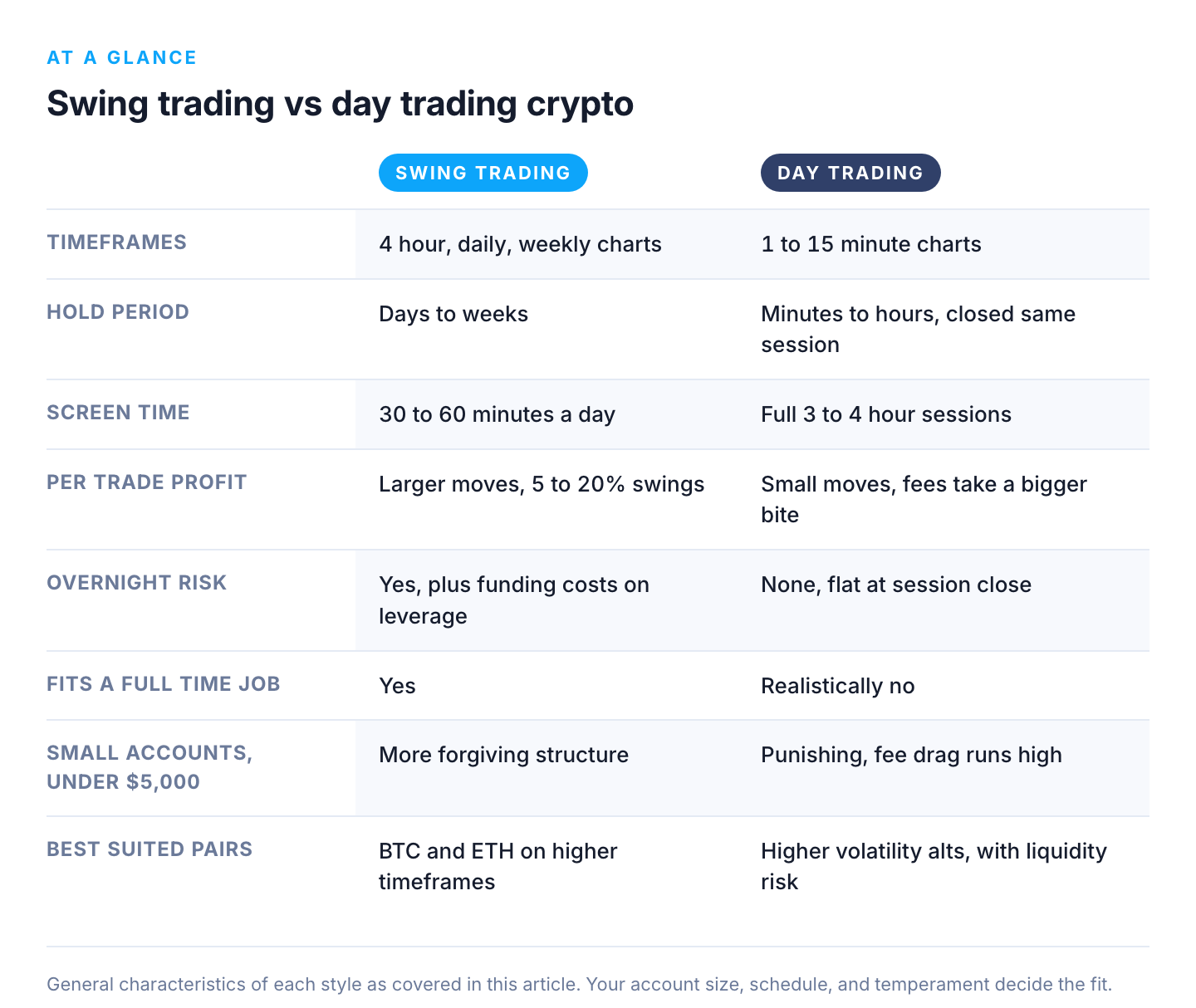
You open positions and close them within the same trading session. No overnight holds. You’re looking for intraday setups: breakouts, reversals, momentum plays, scalps. The timeframes are short: 1-minute to 15-minute charts, sometimes the 1-hour.
Crypto day trading has one advantage over traditional markets: the market never closes. There’s no opening bell, no closing bell, none of the weekend gaps equity traders wake up to. You pick a session, trade it, and close everything when you’re done. Asian session, European session, US session, or whatever window fits your schedule.
The tradeoffs are real, though.
Screen time is high. Day trading requires you to be at the screen for the duration of your session. You’re watching price action, managing positions, adjusting stops. A four-hour day trading session is four hours of active work.
The per-trade profit is smaller. Because you’re capturing smaller moves, each individual trade produces less P&L. You make it up on frequency, with more trades per session and more setups per week. But this means your execution costs (fees, spread, slippage) are a larger percentage of each trade’s outcome.
Account size impacts day trading more than people realize. If you’re scalping for 0.3% moves on a $1,000 account, you’re playing for $3 per trade before fees. At that scale, exchange fees can eat half the profit. Day trading on a small account is structurally challenging because the per-trade profit margins are thin and fees are proportionally large.
How Swing Trading Works in Crypto
You hold positions for days, sometimes weeks. You’re trading on 4-hour, daily, or weekly timeframes, looking for larger structural moves: trend continuations, breakdowns from range, macro reversals.
Screen time is low. You check charts once or twice a day, adjust stops if needed, and otherwise leave positions alone. A swing trader can manage their portfolio in 30 minutes per day. You can have a full-time job and swing trade crypto effectively. That’s not realistic with day trading.
Per-trade profit is larger. You’re capturing bigger moves, the 5%, 10%, 20% swings that play out over days or weeks. Each trade produces more absolute P&L, which means fees are a smaller fraction of the outcome.
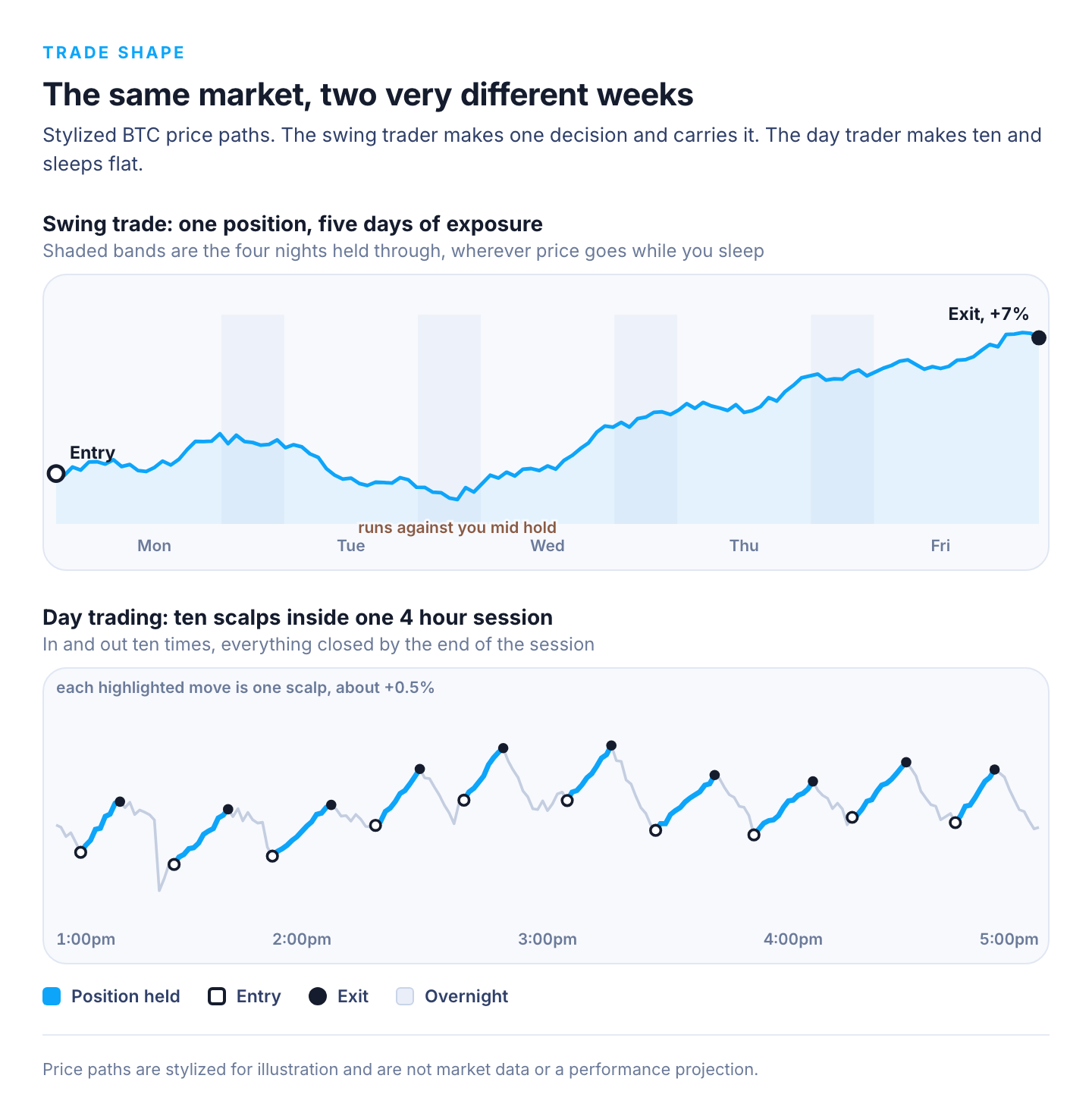
You hold through volatility. This is the tradeoff. Crypto is volatile, and overnight moves can be large. Your 4-hour chart setup that looked clean at 6pm might run hard against you at 3am while you sleep. Swing trading requires you to accept that your P&L will swing between sessions. Not every trader is comfortable with that. If watching unrealized losses on an open position keeps you awake, swing trading will be stressful regardless of whether the setup is right.
Funding rates matter. If you’re holding leveraged positions for days, you’re paying (or receiving) funding rates every eight hours on most exchanges. On Kraken and other major exchanges, funding rates are typically small, but they compound across a multi-day hold. Factor them into your cost basis, especially when the rate consistently runs against your side of the trade.
Which Style Fits Your Account?
This is where the comparison gets honest.
Day trading on a small account is technically possible but punishing, for the fee reasons above plus one more: producing meaningful P&L from small intraday moves on a $1,000 account requires high leverage. High leverage means tight liquidation prices. Tight liquidation prices on short timeframes mean noise in the market can stop you out.
Swing trading on a small account is more forgiving in structure. You’re capturing larger moves, so the fee-to-profit ratio is better. You can use lower leverage because the per-trade target is bigger. But the dollar outcomes are still constrained by the account size. A 10% swing on a $1,000 account is $100. On a $50,000 account, the same trade is $5,000.
The honest answer: your account size determines which style is viable more than your preference does. A trader with $500 who wants to swing trade BTC on the daily timeframe will find that the position sizes are too small for the moves to matter. A trader with $500 who wants to day trade will find that fees eat the margins.
This is one of the reasons some traders move to funded accounts: you pay a one-time fee, pass a trading test, and trade a firm’s capital instead of your own, with your maximum loss fixed at the fee. At Breakout, a $100,000 account gives you the capital to swing trade BTC at 5x leverage with proper 1% risk per trade, which is $1,000 per position. The same approach on a $1,000 personal account risks $10 per trade. Same strategy, same analysis, 100x the capital behind every position.
Choosing Based on Your Situation
Forget which style sounds more appealing. Consider these practical questions:
How much time can you spend at the screen? If you have 30-60 minutes per day, swing trading. If you have 3-4 hour blocks of uninterrupted focus, day trading is feasible. There’s no middle ground here. Day trading with half-attention (checking charts during meetings, placing trades on your phone while commuting) produces worse results than not trading at all. Either commit the screen time or choose a style that doesn’t require it.
How do you handle open positions? If you can set a stop loss and walk away without checking your phone every 20 minutes, swing trading suits your temperament. If open positions in volatile markets cause anxiety, day trading lets you close everything at the end of each session. Be honest about this. A lot of traders choose swing trading for the time savings and then spend more time checking prices than they would have spent day trading.
What’s your account size? Under $5,000, swing trading is structurally more viable because the fee drag on day trading is proportionally higher. Above $50,000, both styles work. In between, it depends on the pairs you trade and the leverage you use.
What pairs do you trade? BTC and ETH are better suited for swing trading. The moves are larger on higher timeframes and the liquidity supports bigger positions. Altcoins with higher volatility can work for day trading, but the risk of gaps and liquidity holes is higher.
What’s your edge? If your best setups come from daily and 4-hour chart patterns, trying to day trade because it seems more active is fighting against what already works for you. Your edge is your edge. Trade the style that matches it.
Swing Trading vs. Day Trading: A Side-by-Side Comparison
Put the two styles next to each other, in a week where both approaches catch their setups, and the tradeoffs get concrete:
A swing trader holding a BTC position for five days, capturing a 7% move on a $50,000 position (5x leverage on a $10,000 margin allocation): the gross profit is $3,500. Minus roughly $30 in entry/exit fees and, at typical funding rates, about $75 in funding across five days. Net: approximately $3,395. Time spent: maybe an hour total across the five days.
A day trader executing ten 0.5% scalps on BTC across a four-hour session, each on a $50,000 position: gross profit is $2,500 (10 × $250). Minus $300 in entry/exit fees (20 transactions × $15 average). Net: approximately $2,200. Time spent: four hours of active screen time.
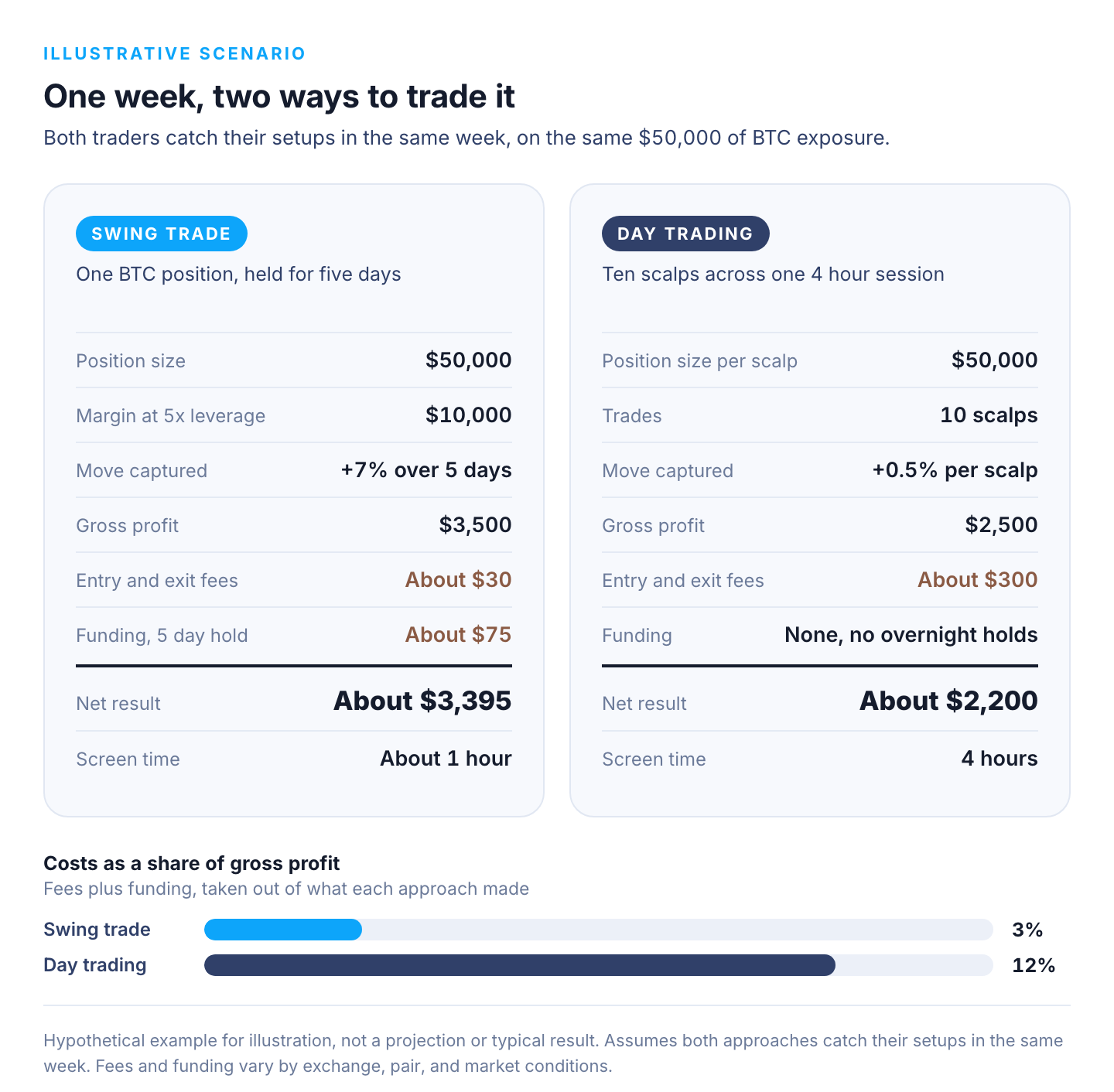
The swing trader made more net profit in less time, with lower fee drag. The day trader had more control over position timing and no overnight risk.
Neither approach is objectively better. But if your account is small, the day trading math is harder to make work because the per-trade profits are already slim, and fees take a larger bite.
Can You Do Both?
Yes, but not at the same time on the same account without a clear system.
Some traders swing trade BTC as their core strategy and day trade altcoins for additional setups during active sessions. That works if the risk allocation is distinct: a fixed percentage of the account for swing positions, a separate allocation for day trades, and the two never interfere with each other.
What doesn’t work is switching between styles based on how you feel that day. “I’ll swing trade this week” followed by “I’ll scalp this afternoon” with no plan is how accounts blow up. Each style requires a different set of rules for entries, exits, position sizing, and risk management. Mixing them without structure creates conflicts.
Pick one as your primary approach. Get consistent with it. Add the second style later if your capital and time allow for it.
Day trading needs screen time and capital to overcome fee drag. Swing trading needs patience and tolerance for overnight volatility. Your account size, schedule, and temperament decide which one fits, not which one sounds better.