
On this page
Most failed evaluations die the same way: sizing that ignores the drawdown budget. The approach that survives treats the evaluation as a risk allocation problem, with numbers.
To pass a prop firm evaluation, you size every trade against the drawdown budget, not the profit target. Traders who fail evaluations usually fail on this single point: they size for the 9% or 10% they need to make, blow through the 3% to 6% they are allowed to lose, and the account is gone before the strategy had a chance to work.
This guide walks through the budget math, how to pace an evaluation, the specific ways accounts breach, and how to pick an evaluation whose parameters fit the way you trade. The numbers use Breakout’s 1-Step products because the parameters are public, but the framework applies to any evaluation.
The Evaluation Is an Asymmetry Problem
Every evaluation gives you two numbers that matter: the profit target and the loss budget. On Breakout’s 1-Step Turbo, that’s a 9% target against a 3% max drawdown. On the 1-Step Classic, 10% against 6%. On the Pro, 12% against 5%.
Read those as a ratio and the job gets clear. On the Turbo you need to make three times what you are allowed to lose. No sizing trick changes that ratio; only edge does. What sizing controls is how many chances your edge gets before the budget runs out.
At 1% risk per trade on the Turbo, the 3% drawdown is a three-loss budget. Three consecutive losers end the account. At 0.5%, you have six. At 0.25%, twelve. That’s the entire sizing decision on an evaluation: how many consecutive losses your worst realistic streak produces, and whether your risk per trade leaves room for it.
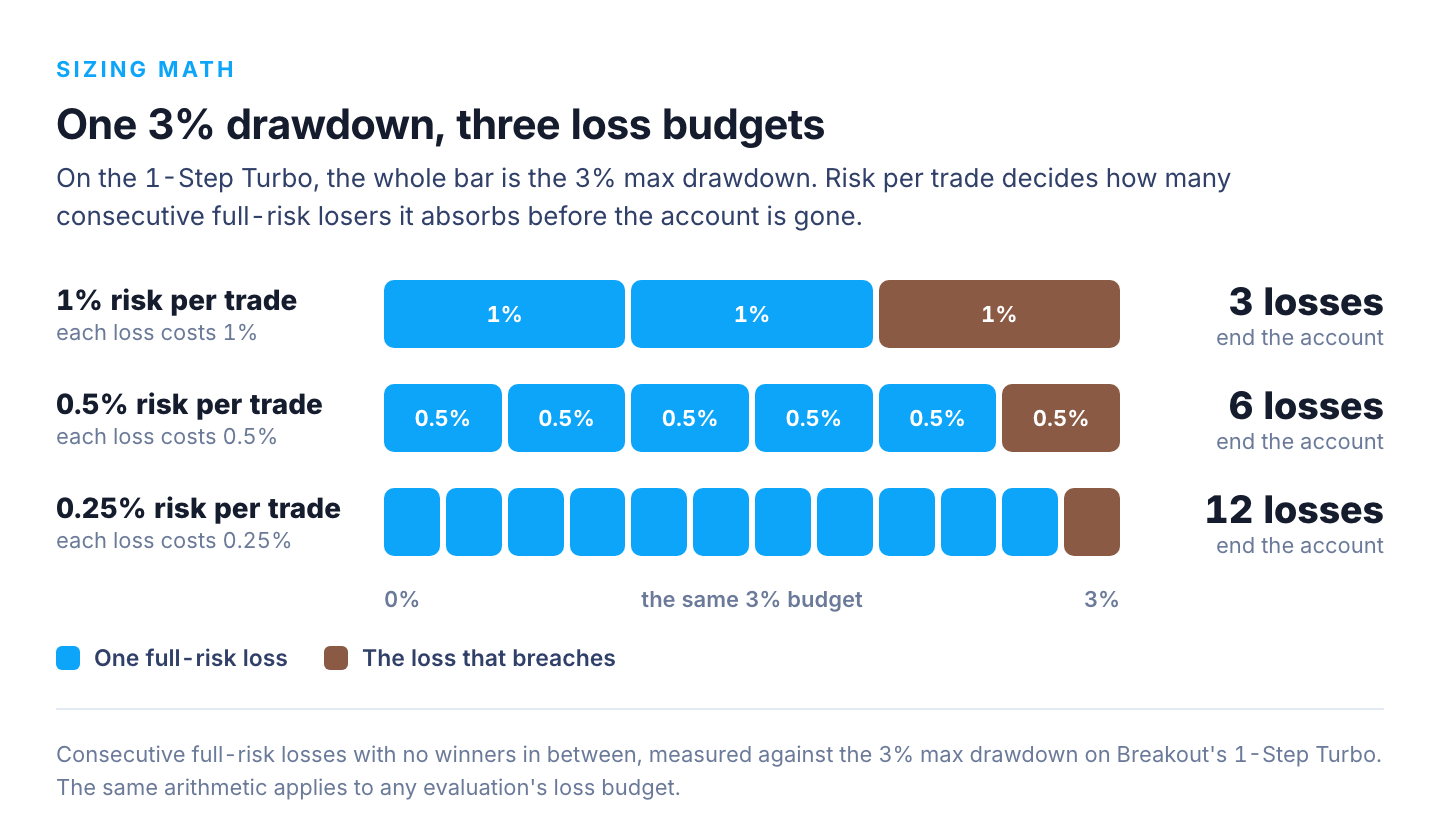
Run your own numbers before you buy. If your strategy wins 45% of the time, a streak of four or five losses is a normal month, not bad luck. Sizing at 1% on a 3% budget means a normal month can end the account with the strategy performing exactly as designed. Either size down or buy the evaluation with the bigger budget.
Sizing to Survive the Streak
Work the arithmetic forward on a $100,000 Turbo account with a 9% target.
At 0.5% risk per trade with winners at 1:2 risk/reward, each win adds 1% and each loss costs 0.5%. A run of 12 wins and 6 losses, a 67% win rate over 18 trades, nets +9% and passes. The same trader at 1.5% risk hits the same target in a third of the trades (4 wins, 2 losses), but those two losers alone reach the 3% line and end the account if they come first. Same strategy, same edge: one sizing survives variance, the other needs the wins to arrive in a friendly order.
The daily loss limit adds a second, tighter constraint. Breakout’s products all carry a 3% max daily loss alongside the total drawdown. Two 1% losers and one 0.5% loser inside a single day is 2.5%, one normal trade away from a daily breach even though the total budget looks healthy. If your style produces clustered entries, correlated positions count as one trade for risk purposes. Three longs on BTC, ETH, and SOL in a selloff lose together, and the daily limit does not care that they were technically separate ideas.
The practical sizing rules that come out of this arithmetic:
- Set risk per trade so that your worst realistic losing streak consumes at most half the total drawdown.
- Cap the day: stop trading when the day’s losses hit half the daily limit, so one more normal loser can never breach it.
- Count correlated positions as one position when you tally open risk.
Pace: The Clock Is Not Real
Most evaluation pressure is manufactured by a deadline. A 30-day time limit converts a trading test into a pace test: miss a week to travel or a flat market and suddenly you need 9% from three weeks, which pushes size up and quality down.
Breakout puts no time limit on the evaluation and no minimum trading days, so the pace pressure disappears in both directions. You can take four months of selective setups, and you can also pass in one trade if the position gets there, because the account auto-upgrades to funded the moment equity hits the target, even with the position still open.
Trade the evaluation at the exact pace your strategy produces setups. If your edge generates three good trades a week, taking a fourth to “make progress” is how the budget leaks away on B-grade entries. An evaluation without a clock rewards the discipline you already have; it does not require a new personality.
The one pace adjustment worth making is at the start. The cold-start problem is real: a loss on trade one puts you in immediate deficit against the budget with no cushion. Opening at half your normal risk for the first handful of trades, then stepping up once the account is positive, buys insurance at the cheapest point of the whole attempt. It costs a slower start. It removes the scenario where a routine opening streak forces you to trade the rest of the evaluation from a hole.
How Evaluations Actually Fail
The breach patterns are consistent enough to list.
Revenge sizing after a loser: The most common. A 1% loss becomes a 2% “recovery trade,” which becomes a 3% hole and a breached daily limit by the afternoon. The fix is mechanical, decided before the day starts: after two losses, the day is over.
Oversizing the A+ setup: The conviction trade that justifies 3% risk works until the one time it does not, and on a 3% budget that single trade is the account. High conviction earns your maximum standard risk, never a multiple of it.
Ignoring the daily reset mechanics: Daily loss limits recalculate from your balance at a fixed reset time (00:30 UTC at Breakout). Traders who breach on this one usually held overnight positions without rechecking what the new day’s limit meant for their open risk.
Passing the target on paper, then giving it back: On evaluations with minimum trading days, traders hit the target early and have to keep trading, sometimes back below it. This failure mode does not exist at Breakout: hit the target and the account converts on the spot.
None of these are strategy failures. Every one is a sizing or process failure, which is the good news: process is fixable this week; edge takes years.
Picking a Prop Firm Evaluation You Can Pass
Matching the product parameters to your style is the decision most traders skip, and it is worth real money.
The tight-budget products are cheap because the budget is tight. Breakout’s $100,000 Turbo runs $330 with the 9% target and 3% drawdown. That price fits a trader with tight stops, high selectivity, and a documented history of shallow losing streaks. If your equity curve regularly dips 4% to 5%, the Turbo’s price is not cheap, because you will pay it more than once.
The wider-budget products cost more and forgive more. The $100,000 Classic at $800 carries a 10% target against a 6% drawdown: double the Turbo’s runway for a target one point higher. The Pro sits between, $545 for 12% against 5%, priced for traders confident in a higher target who still want breathing room. The honest way to choose is from your own trade log: take your worst 20-trade stretch from the last six months and check which budget it would have survived.
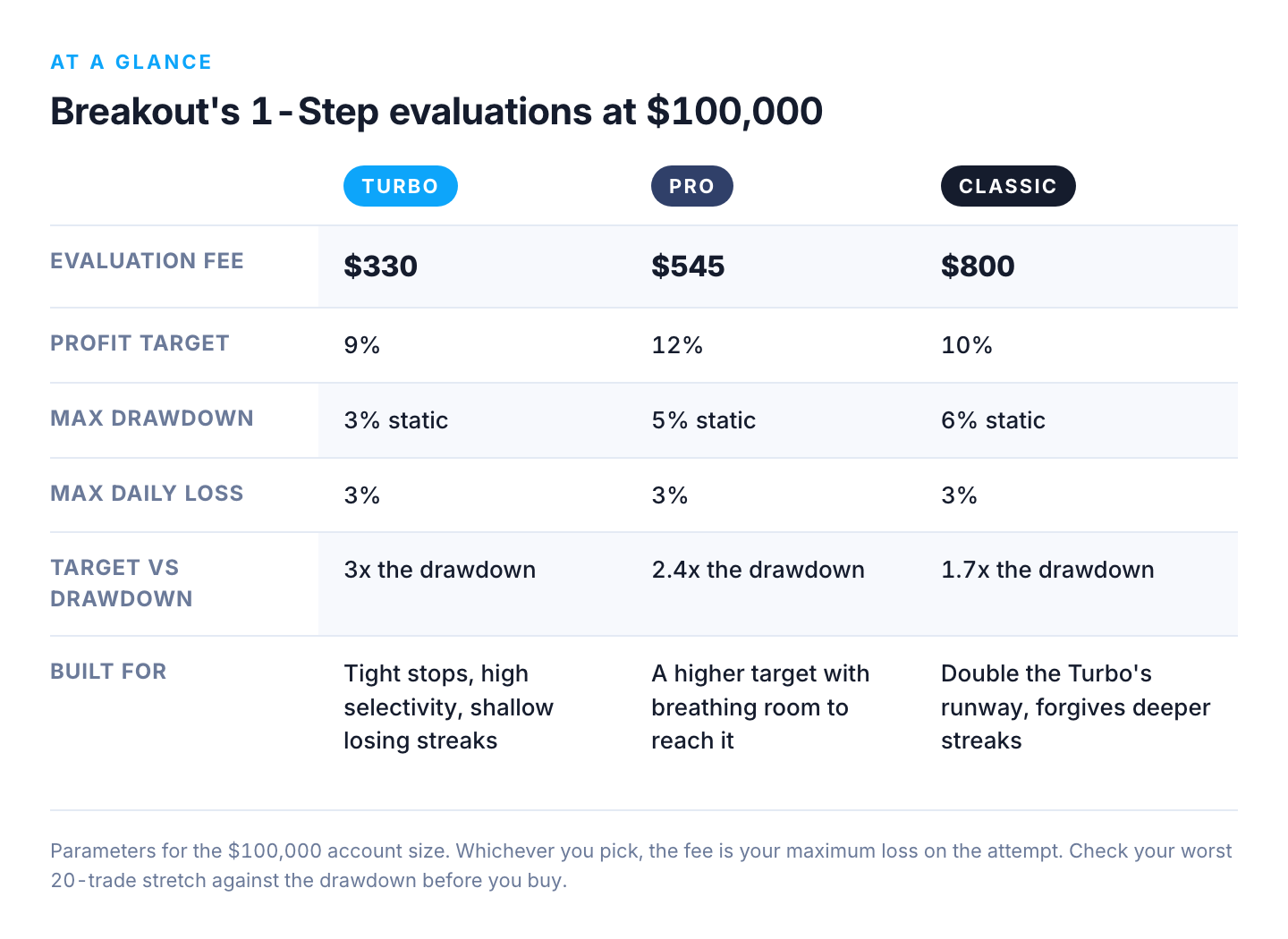
Whichever you pick, the downside is identical and fixed: the fee is your maximum loss on the attempt. A failed evaluation costs the fee, nothing more, and trying again is a new purchase, a fresh account with a fresh budget.
After the Pass
What happens post-evaluation matters to how you trade it, because the funded account carries the same loss limits as the evaluation. The sizing discipline that passed the test is the same discipline that keeps the account. Breakout removes the target on funded accounts: there is nothing to hit, only limits to respect, with 80% of profits yours (90% with the upgrade) and payouts on-demand.
The evidence that the model pays sits in public: $50M+ paid to traders since launch, a payout leaderboard on the site updated monthly, and a #payouts channel in Discord confirming withdrawals in real time. Breakout is backed by Kraken and has operated since November 2023. Verify all of it before you buy anyone’s evaluation, including ours.
The full risk management framework that underpins all of this applies double on an evaluation, where the loss limits are contractual instead of aspirational.
Passing a prop firm evaluation is a budget allocation problem: size so your worst realistic losing streak fits inside the drawdown, cap the daily damage, and let the target arrive at your strategy’s own pace. Edge passes evaluations. Sizing decides whether it gets the chance.